Don't talk about being a screenwriter. Sit your ass in the chair, and even if it takes you ten years -- or nine years, like it took me -- to start working as a professional, develop and hone your skills. Don't think that the first thing you're gonna write is gonna sell for a million dollars, 'cause I got news for you: It ain't.
0 Comments
Where to start?
There are no hard and fast rules to this. But if I had to do it again. This is probably a route I would consider taking.
If you have all this, that's great. Now you need to structure everything into a story and put it into screenplay format. But you've never done this before. You have no idea where to start. Before you get started: Read 20 produced screenplays. Ones that are in the same genre as the one you want to write. If you want to write a horror. Read horror. If you want to write a comedy, read comedies. Then watch the movies and see how things translate from the page onto the screen. Have a look at how they do it. When do things happen to the main characters? At what point does the main character's life change? When does the protagonist leave their comfort zone? These are the types of things you need to be looking for. After you've done this. Reread the screenplay.
Now you need to join a peer review site where you can read amateur screenplays. Out of all the ones on the web, my favorite one is Trigger Street Labs. Lots of information. And the best thing. It's all free. You need to start reviewing screenplays. If you've never done this before. It can take a bit of getting used to. Especially if you don't actually know what you're looking for because you're just starting out yourself. So before you do your first review of a screenplay. You need to go to the forum and check out how the spotlighted reviewers do their reviews. Find out how they review and evaluate a screenplay.
This is one of the best ways to learn how to structure a screenplay. You now need to start reviewing and giving feedback. It doesn't matter what genre you get. You're here to read and give an honest evaluation of the screenplays you read. Before you even consider even writing that first screenplay. You will need to read and evaluate around 20-30 screenplays to start. You'll find that the more amateur screenplays you read , the better your feedback will get. You'll start noticing things and trends that will help when you come to writing and structuring the story of that first screenplay. While you're doing this, you should be coming up with plenty of ideas for your screenplay. The more you have, the easier it will be to structure your story. Once you've done this. You need to start structuring your story. ACT 1 Setting up your main characters. What does your main character want and need? What are their internal and external goals? ACT 2 Probably the toughest of the acts to write. What's the main plot? What are the secondary plots? Does the main plot cross the secondary plot? This is where you get the ups and downs of the story. ACT 3 Does the guy win the girl? Does the good guy defeat the bad guy? Usually the ending is the opposite of the start? Not all the time. But usually it's the opposite. The above is pretty simplistic. But it gives you a rough idea as to what should happen. I wouldn't buy any books at this stage either. You pretty much want to write this on your own, under your own steam with no one else's influence. You now need to write it. Give yourself a deadline. Twelve weeks should be enough. Especially if you've planned and outlined it well. Once you've written it. You need to put it away for a couple of weeks. While it's sitting in a drawer. Come up with other ideas for other projects. After two weeks, come back to it and go through it. Rewrite scenes if you need to. Change dialogue etc. Now you need to upload that sucker onto Trigger Street Labs and get some feedback. This can be quite daunting and you need to grow a thick skin. Because some reviews will get under your skin. But remember, this is for a good cause. This is to improve your story in the long run. While reviews are coming in. You should continue reviewing. You'll probably want around 10 to 20 reviews. Make sure you print off the reviews before taking down your screenplay. Put it away for a week and come back to it and the reviews with an open mind and fresh eyes. As writers, we can get too close to our work. Look for common areas and problems that have been brought up. Perhaps ACT 1 is too slow. Maybe you have a couple of characters that could be combined into one. Maybe you need to cut pages because it's too long. Ideally 85 – 115 pages or less. Then the rewriting starts after this. Good Luck. Notes taken from Luke Ryan's session at London Screenwriters' Festival 2012
Most Important Things Know and understand who you're pitching and querying to.
Writers earn a living by writing.
As a writer you should be easy to work with. And have excellent ideas for projects. PURPOSE OF PITCH To make the person you're pitching to say: "I have to READ/BUY that!" Using as few words as possible. CONFLICT most important component of STORY. Testing HERO. CONCEPT and PREMISE Concept = BIG IDEA Premise = The way into the BIG IDEA. Ideally the story needs to be:
LOGLINES A Good logline: Captures the most interesting ideas in the story within one or two sentences. Gives us a clear idea of character, tone and stakes. Two vital parts The BUT and the MUST. GIVES US A A (CHARACTER) sets out to (ACHIEVE A GOAL), but (RUNS INTO AN UNEXPECTED & SOMETIMES IRONIC OBSTACLE) and must (GROW IN A WAY TO TRIUMPH OR FACE CERTAIN DOOM). Is this something other people want to see? Is this something I can write the hell out of? QUERYING -- Managers -- Agents -- Producers ALWAYS REMEMBER TO WORK THE ASSISTANTS Find out who writes like/similar to you? Actually do a proper letter rather than email.
Where to start?
Sometimes you discover something that you enjoy doing. Even though it's hard work, you do it and you keep at it because you enjoy doing it. I'd always wanted to write. I think this was because I enjoyed reading as a kid. You pick up a book and you can let your imagination run wild. When you pick up a book and read it, how you imagine what's going on and how you see the characters, the world, will be different to someone else who reads the same book. That's what's so great about reading, everyone will have their own personal experience and how they connect with the material will be different. So when I discovered screenwriting. It was the best of two worlds. I enjoyed reading when I was a kid, but I also enjoyed the movies. And screenwriting was a way into both. I got into the game a little late. I wish I had gotten into it sooner. But I don't think that's a reason not to do something. Can you put an age limit on what you enjoy doing? Should you let that stop you? I don't think so. And that's a whole different blog. Writing that first screenplay. I got into this after I had been to see a film. It wasn't a bad film, but it wasn't what I had been hoping for. I was rather disappointed when I left the theater. The following day, I tried to find out some stuff about writing a screenplay. I found some information on format and decided to have a go. I wrote a very sketchy outline and jumped straight in writing this thing. I had no idea what I was actually doing. I think it took four or five months to complete. It was a superhero amalgamation. At the time of writing, I wasn't aware of copyright issues or that it was a complete waste of time. You could say that it was some terrible fanboy script. I finished it and was extremely proud of this thing that I had written. It wasn't very good. It had a good idea at the heart of it. But no matter what I did. It would've turned out bad. It was this that got me into the world of screenwriting. Do I wish that I had done it differently? No. I hadn't read any books. I hadn't read anything on the internet about story structure. The only thing that I was aware of. Was format to some degree. I think one of the best ways to get into this. Is to watch movies and read a bunch of produced , unproduced and amateur screenplays and analyze them. See what you connect with.
Books are good. Don't get me wrong. And there a couple of good ones around. But to get the most out of them. I think you should write two or three screenplays first. Get a feel for writing first. Then buy a couple of books. Read through them. Then you can apply some of the techniques to some of your projects and see if they work. But remember, you are the writer. It's your world. The world you're putting down on the page is your creation. That's the job of the writer. No book, seminar is going to write a story for you. That's your job. You are the writer after all. And the only way you'll improve is by writing as much as possible and getting feedback on your work. Most of the time. Writing is rewriting. I really hope some of that makes sense. Keep at it. A nice little article to read over at Go Into The Story on how to deepen your understanding of the craft of screenwriting.
Very useful. I read a minimum one screenplay a week. And try and watch as many movies as I can. Old and new. If you can.
Also read as much as you can. Screenplays. Novels. Short Stories. Newspapers. Watch documentaries. You never know where that next idea might come from. Keep feeding that imagination you have with as much information as possible. Don't forget to write ideas down as well. Get yourself a little black book. Keep writing. Serve
Passion Work Focus Persist Ideas Good Push This will be short and sweet. Haven't blogged for a while.
One of the best things about being a screenwriter, is you get to make stuff up. Whether you're a paid professional, an amateur trying to break in or even someone who does it as a hobby to pass the time. Not entirely sure why you'd want to do it as a hobby to pass the time. It's hard work. Perhaps you have an overactive imagination and you feel compelled to write. But each to their own. You get to make stuff up. You get to delve into your imagination and create worlds, situations, dialogue that could only be possible in the movies. Well, that's not strictly true. You could write novels and short stories as well. But we're talking about creating a story within a certain amount of time. A certain amount of pages to convey your story, your character's wants and needs. But that's what makes it such a challenge. As screenwriters, or any writer for that matter, we have the opportunity to use these stories that form in our imaginations and gestate in our subconscious over days, weeks, months and even years. As screenwriters we can pluck out what's in our heads and put these ideas down on paper and hopefully create an interesting, exciting and cohesive story over a period of time. With memorable dialogue, situations and characters, not to mention, eye popping locations. But it takes time, hard work, dedication to learn the craft and a willingness not to give up. In it for the long haul. As long as you have an imagination, creativity and the want and need to write. Do it. The only person that can stop you, is you. So get cracking and get writing. Not sure if any of that makes the slightest bit of sense. Write, write and keep on writing.
Don't be afraid of starting over. It can be gut wrenching to get rid of entire acts or characters. Or to completely start over. But this is what makes it fun, this is what makes it a challenge. This is what makes it rewarding when you finally type FADE OUT. Remember, it's your world, you can do whatever you want to it. Have your characters say or do whatever you want. Have them go places that you can only dream about. As writers, you must remember that once something has been written, once you've written something, it's never set in stone. It can always be changed, scenes can be removed, new scenes can be added. The story can be changed from one character's viewpoint to another's perspective.
Never be afraid of rewriting your world to make it better. Writing is rewriting. Get those ideas down on the page. Get that first draft written. Because the hard work and fun starts in the rewriting. Never be afraid of changing things. It's your world. You're in charge. Just some random ramblings for the day. Keep on writing. As you guessed, this is about screewriting software and whether or not you should be buying any when you first start writing. It feels an age since I last wrote. Things are pretty topsy turvy at the moment. I'm hoping to have my feet planted securely on the ground at some point soon. You may think this is rather naïve or ignorant on my part, but I had always assumed that a screenplay or script was made up of dialogue. That's all I ever imagined a screenplay consisted of, just dialogue. Kinda silly really. I always imagined that the director, actors and production crew all figured out the rest as they went along. They figured out set locations etc just from dialogue – right. How stupid is that? I've come to the conclusion that it would be pretty darn impossible if you received a screenplay and it was written with streams of dialogue all the way through. Impossible, you couldn't do it. I don't think you could. My first screenplay that I attempted to write, very badly I might add was written using a template for Microsoft word that I found at BBC Writersroom. I'm not sure if you can still get this template. I used this template to write my first ever screenplay that I thought was going to change the world. Obviously not. PRINCESS LEIA I don't know where you get your delusions, laser brain. I must concur. Anyway, for my next screenplay I hunted around on the internet some more and finally came across some fantastic free software for screenwriters going by the name of CELTX. You have to remember that you don't have to pay for this, it's completely free. An open source software for writers. I downloaded this and began to use it. This is a fantastic little bit of kit. In my years using it, I've only really had two issues with it. But again, you have to remember it's free. You don't have to pay anything for it. When you open the program you get the choice of not just screenplays but also the chance to write for film, audio-visual, theatre, audio-play, story-board, comic book, text and novel. 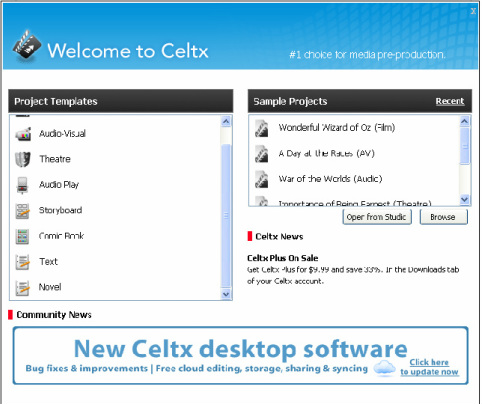
As you can see from the splash screen above, you get a list of project templates and all you have to do is click which ever one you require. 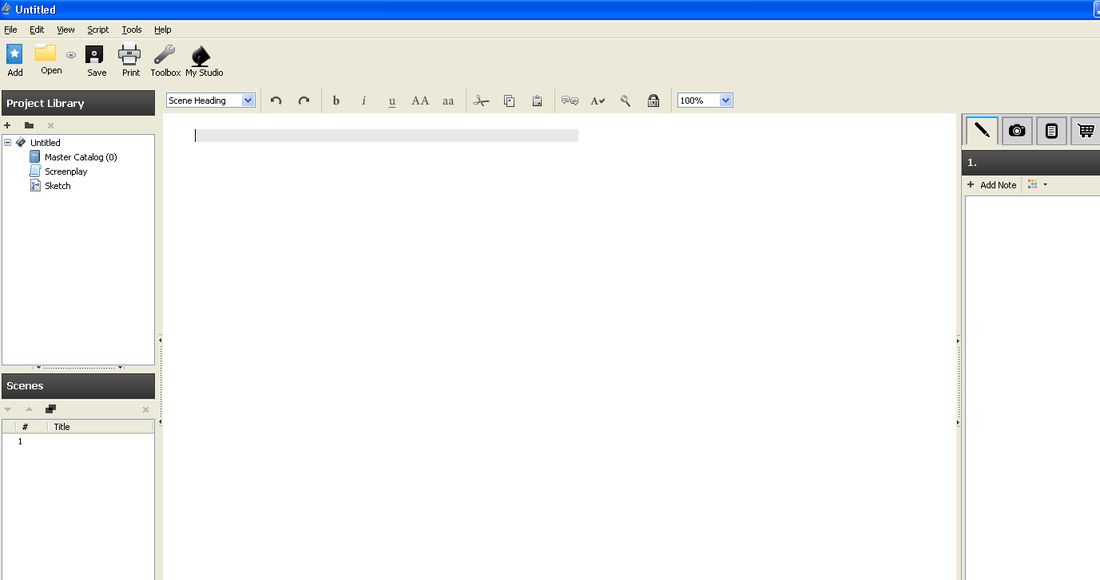
Scene headings and character names are automatically remembered. Should you spell a character name wrong and press the return key. You do have the ability to delete unwanted names.
There are only two things that I find annoying in this software. In order to convert a file to Pdf you need to be online and the really annoying one, the software has the habit of leaving large spaces at the bottom of the page and occassionally the dialogue will be off, again with large spaces. Not sure why. This is frustrating because it makes it difficult to calculate the actual page count of the project. Other than that, I would highly recommend that if you are starting out and you truly want to see if you have the writing chops as a screenwriter. Then I would suggest that you download yourself a copy and get writing. I definitely would recommend that you hold off on buying anything if you are just starting out. Write a few screenplays, write several before splashing out. I've been writing for a while so I decided to make the leap and buy myself some software. I opted for Final Draft 8 which seems to be the one every one uses. Although saying that, as long as the software you use formats the pages correctly, is easy to use and can convert into a Pdf then you don't have anything to worry about. I haven't been using Final Draft 8 very long, so I'm still getting used to it. I have found that it formats pages correctly. Unlike CELTX however, as far as I can see so far, you don't have the ability to see scriptnotes that you make along the way. Also in CELTX you have the ability to make notes under the script and keep them open. Final Draft should consider implementing this at some point. The only other thing about Final Draft, it seems to use a heck of a lot of memory. As soon as I start typing, the fan on my laptop kicks in. Which can be a little annoying. There's plenty of other software out there that you can use. I've just visited BBC Writersroom and discovered Page 2 Stage which you can download for free. It works with Microsoft Word I think, you'll need to check. This may be similar to the software that I originally started with. Worth checking out. Then there's Movie Magic Screenwriter Movie Outline 3 Scrivener Page 2 Stage If you are planning on buying. Don't rush into it. Download the demo versions and try them out. What's good for one, won't be for others. When you feel ready to buy, go out and take a look. N.B. There are probably plenty of others. Just don't rush out. Get the lay of the land first, before spending any money. And Good Luck Currently at the moment I have limited access to the internet which is making things difficult but not impossible. This is a quick follow up to the previous blog that I did before the new year. As my circumstances are changing this year I thought it wise to join a couple of sites for screenwriters trying to break into the business. There were two sites offering a chance to create a profile for a small fee that I felt warranted attention. Production Arts Group and Shooting People. Haven't joined Shooting People yet. For those of you that have seen what Production Arts Group are doing and are considering it. This is what you get for your money after you join up. You get the chance to create a nice profile page, here you can add your writing credentials, how long you've been writing etcetera. You can also create a page with all the screenplays that you've written. This will include the title, logline, genre etc. 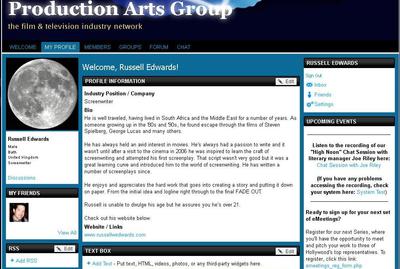
Production Arts Group
You can't really see above. But you get the general idea.
There is also a forum that you can access to ask questions about the industry. I think there are around 300+ members on the site at the moment. With around 14 managers and agents. You can't pitch any of your work to them unless you join the e-meetings that they hold once a month. This can be done for an extra fee. Members receive discount. If L.A. is out of your sights for the foreseeable future, then this is probably a route worth considering and taking. The cost of becoming a member is $59 for one years membership. If you have the funds then it's probably worth checking out. It can't do any harm apart from burn a small hole in your wallet. If you have time to participate and have internet access then you might want to join one or more of the e-meetings. Just make sure you have a large body of work and that's it's written to the highest standard possible. You can pitch your work to the managers and agents, usually three of them are on one of these e-meetings. But do some research beforehand, find out the types of work they're interested in etcetera before jumping in with all guns blazing. You can check out their profiles on the site beforehand. There are no certainties and no guarantees that you'll pick up an agent or manager but you never know. Again, make sure you have a large body of work on offer and it's written as well as it can be . Best of Luck  All the best for 2012.
Work hard and get those scripts written. I’m always amazed at the number of basic spelling and grammar errors I make. You can probably throw in punctuation and syntax as well. It's just not very good.
I’ve concluded that my spelling and grammar have both seriously gone downhill in the last ten years or so. This is a little depressing. I think it’s down to the fact that I don’t read like I used to. There was a time when I would read lots of novels, but these days I usually find myself reading screenplays. Not that’s a bad thing, that's a good thing, that’s what I do now. I write screenplays. From a writing point of view, a writer needs to read as much as possible to keep that gray matter ticking over. If you don’t read, how can you expect to write? A screenwriter writes for readers, so you have to look at it from their point of view. A few grammar issues and spelling mistakes can be overlooked. However, if there is a consistent and constant bombardment of these types of errors throughout your screenplay. Especially on that opening first or first five pages or so, what impression is that going to give the person reading your work? It’s probably going to make a negative impression and they may then conclude that if you’re this careless with your spelling and grammar. What hope is there for your story? Even if you have the coolest concept and have executed it to the highest standard possible. The screenplay might end up getting tossed in the trash by the (yikes) fourth or fifth page. In conclusion, check your spelling and grammar the best you can. Put it in a drawer for a couple of weeks and come back to it with a fresh pair of eyes. If you can get someone who's good at spelling and grammar to read through it, even better. Common words that get mixed up. Access / excess Accept / except Practice / practise Licence / license Advice / advise Their / they’re / there You’re / your Who’s / whose Affect / effect Every day / everyday Were / where / wear / ware / we’re Cite / site / sight Principle / principal Assure / insure / ensure Whether / weather I usually get these confused when I haven’t actually bothered to take the time to read what I’ve written. And it can be quite frustrating. So I wonder what it must be like for someone reading my work. Check your spelling and grammar. There comes a point when you need to market yourself as a screenwriter. It's no good having the work if you're not prepared to put your name out there. With the rise of the internet it has become that much easier to advertise yourself. Especially if getting to L.A. and Hollywood seems out of reach for the time being. The internet is a good place to start promoting and selling yourself as a writer. After a few years of writing I decided to create a website as a way of showcasing myself and my work. It's a great way to market yourself, it also gives people an idea as to who you are and what you have to offer as a writer. It's pretty cheap nowadays to create your own website and buy a domain name. Personally I think it's a worthwhile investment and shows that you take yourself seriously as a writer. There are plenty of websites out there that charge fees such as InkTip and MovieBytes etc for the privilege of showcasing your work. But why pay them when you can do it yourself? I'm not saying you shouldn't use these services, in fact, if you have the funds to do both, why not? It certainly won't do any harm. Let's look at what's available for free in the way of websites. There are four websites where you can showcase your work and get feedback. You can use these sites to showcase your work and get feedback from other writers. Especially if you find it impossible getting feedback. Here you'll find like minded individuals who'll give their honest opinions on your work. You may not always like what you hear and what they tell you. But getting feedback is key to improving as a writer. Anyway, I'm going off on a tangent. Let's get back on topic. But is that enough? There are other sites where you can set up accounts for free to market yourself. These are just a few. Once you've created your website and are happy with it, you may want to buy yourself a domain name to add that professional and personal touch. Apart from your domain name you certainly don't need to splash out lots of money on getting someone to design a website for you. You can do it yourself. What about paying sites to market your work? There are plenty out there and if you have the funds to do it, why not? InkTip MovieBytes What about getting your work to somebody that can do something with it? Due to circumstances and to kick start the new year I'll be joining a couple of websites to promote myself and my work. There is a cost to these sites. Only a small cost and if you can afford it, do it. If you have a large portfolio of work under your belt then it's probably worth doing. If you're just starting out and have a few screenplays under your belt then it's probably not worth doing just yet. Build up that portfolio of work, keep writing and keep getting feedback to improve your work. The more you write, the better you'll get. Practice, practice, practice!  Shooting People:Independent Filmmakers Network  Production Arts Group Both of the sites above charge a small fee for an annual membership. If you have plenty of work under your belt and you have a good work ethic then you should give it a go. It's another way of marketing and selling yourself. Being Proactive.
If you can afford it, give it a go. It certainly won't do you any harm. Just make sure you have a large body of work under your belt first. Always remember, they'll be asking this if they're interested. 'What else do you have and what are you working on at the moment?' It's alway good to be working on a project or projects. Hopefully you will find something useful here. This doesn't mean you should change what you're doing. A writer should be spending 95-99 percent of the time they have available to them to WRITE. That's what you love and that's what you want to do. To be a professional screenwriter. So you must write. Possibly 1-5% of the time available to you should be used in marketing yourself and your WORK. Because at the end of the day. It all comes down to the writing and what you have to offer as a screenwriter. You need to be in this for the long haul. It's a marathon - not a sprint. In Part 2, I'll try and show you what you actually get when you join these sites. What information you're allowed to put on the homepage and that type of thing. Hopefully do some screenshots. That probably won't happen until the new year, possibly sooner. An informative article about organizing your time and writing from ScriptShadow.
I must agree with writing 3-4 screenplays a year. Ideally more if you can, think about it. After several years if you've written 5 per year that'll give you 35 projects. You can then choose maybe 3/4 of those projects to concentrate on while working on others. Don't put all your eggs in one basket and just write 1-3 screenplays. The larger the body of work you have (portfolio), you'll give yourself a much better chance of someone liking something you have. Or they may not like the projects necessarily but they may admire your style of writing and work ethic and thus give you the opportunity to write something for them. And get paid for it. If you want a career in writing then you must write. Build up that body of work. The harder you work and the more you write, the more luck you'll create for yourself and sooner or later someone will sit up and take notice of you. Be persistent and never give up. Getting feedback on your work can be hard at the best of times. Getting feedback from trusted people with experience in writing, whether it is novels, screenplays or short stories can be extremely difficult.
As a writer you want to get feedback from people that understand how to construct an entertaining story. A story that will keep people interested and entertained. They understand the dynamics that go into creating a story. They understand story, structure, dialogue etc. You certainly do not need to pay someone a load of money to critique or evaluate your story. There are plenty of sites where you can get plenty of feedback and opinions on your work for free without paying over the odds for it. At the end of the day you’re looking for feedback that will help you make your story, characters better. Sometimes when you get this feedback, it might rub you up the wrong way and you may want to take a few jabs and punches at them because they haven’t really understood what you’ve tried to convey in your story. Perhaps they’ve misunderstood your characters motivation, dialogue etc. They may not have liked your writing style, or maybe the story completely flew over their heads. It’s up to you as the writer what you should take and leave from people’s feedback and opinions. Don’t get all pissed and defensive just because you don’t agree with their point of view or ideas for improving your story. Leave it and come back to it another day. If they didn’t understand the story. Ask yourself why? What can I do to improve it? How can I get the message across to the reader? When someone offers to read your work and spend a couple of hours of their time reading and writing up their opinions on it. Say thanks or be thankful. No one’s forcing them to read it at the end of the day. And that one idea they give you, that one kernel of knowledge might be the very thing that strengthens your story and work. Putting your work out there for people to read and evaluate is a tough thing to do. It’s not easy listening to someone be critical of something you’ve written or created. Being able to take on board feedback and use that to your advantage is the trick to improving as a writer. Of course, not everything that they say will be of value or even useful. But you never know. Nobody knows anything! You need a thick skin or be able to grow a thick skin fast. Otherwise you won’t last the distance. And at the end of the day, it’s just someone’s opinion. It may be right, it may be wrong, it might work, it might not. It’s up to you as a writer to decide and figure out what to use and what to leave. Remember, it’s your story at the end of the day. Just be thankful that someone, anyone has even bothered to take the time to read it at all. Because they didn't have to. Write – Get Feedback – Rewrite and keep writing. You can read all the books in the world and attend every seminar and class going. Although this would probably be a very expensive thing to do. But the simple truth is, no matter what medium you have a passion to write in. Whether you write short stories, plays, novels, screenplays or anything else out there.
When you get down to it, the only way you’ll improve as a writer and become good at writing is basically and it’s real simple. WRITE, WRITE and WRITE AND THEN REWRITE And Rewrite some more. Develop your skills, discover the genre or genres that you're passionate about, develop your own unique voice, writing style and put your own personal trademark into your writing. Don’t forget to read everything and anything, watch movies, read screenplays and put your work out there for feedback. Build up a body of work, create a website, take yourself seriously as a writer and market yourself. You might have written a thousand novels, screenplays, but if no one knows you’re a writer, how do expect to get noticed? But most importantly WRITE. Not as easy as it sounds. Especially if you have a large pool of ideas to work from. The trick is not to worry about the current market or where it might be going. It’s impossible to predict. Write the story that interests you, the story that you’d like to see on the big screen or the little screen. There are no magic formulas for working out what’s going to be hot or not next year or what someone might be buying a few years from now.
Write what you know = Write what interests you = A story that will make your creative juices flow. Whether it’s a romance or a hard hitting action movie, if it’s not something that interests you or something that you wouldn’t want to watch yourself. Why write it? Write, write, write and keep writing. Get those outlines written and get those first drafts written as quickly as possible. The real writing happens when you start those rewrites. HAN SOLO Here's where the fun begins. Star Wars (1977) N.B. Working on a number of projects will also help if you suffer from writer's block. Or you get stuck, lost on a project or have no idea where to take the story or a character. You can put your energy into the other project or projects you have on the boil. While doing this, you'll give yourself some breathing space to meander and reflect on what course of action to take and which direction to take your story. Where do you get your story ideas from?
Do you go looking for them or do they just randomly pop into your sub consciousness and stay there? Until one day they just reveal themselves. Ideas can come at anytime. You could be taking a breather from writing and gone for a walk. Dreams can be a good source if you can remember them. Documentaries. Books, novels. You may well be watching a movie and think, ‘hey, that’ll make a good movie’. A newspaper article may give you an idea for a story. You’re at your local supermarket. Anything and anyone could inspire you. This is why you should always carry around your little black notebook. There’s nothing worse than coming up with an idea. Only to find that by the time you get home you’ve forgotten it. Always keep handy, a pen and your little black notebook. Random ramblings on outlining.
A screenplay in itself is a blueprint for a movie. It is not the final product. It is merely an outline that will be used by the director, production crew, actors, visual effects etc to work from. There are many methods a writer can use to get this crucial element down on paper. A writer may use a treatment, outline, beat sheet, whiteboard, index cards or a combination. There is no right or wrong method to this process. A writer will probably find themselves using various methods before adopting one that best suits their own needs in structuring a story. The more detailed an outline the easier it will be to navigate from A to B. A screenplay is structure, 3 Acts. The beginning, middle and end. Consisting of setups and payoffs. The more detailed the outline the easier it will be to see where the story is working or not. Should a writer use an outline? Even if the outline only consists of a few lines detailing the 3 Acts. This will prove an invaluable tool to the writer who will know where the story starts and where it will end roughly. A good outline will help with the overall sructure of the screenplay. A screenplay in itself is an outline, a blueprint for a movie. It's the starting block that everyone will use to create something visual to put on screen. From the director, special effects department, producer, casting director, sound crew etc. A screenplay will be used by various people to bring a story to life. In order to get this story down on paper a writer must first have an idea and a rough plan where to start the story and finish it. Otherwise they'll be writing blindly without any clear objective or goal. They won't have a clear first, second and third act. A beginning, middle and end. Setups and payoffs. This is where creating and having an outline will come in handy. It will give structure to your three acts within the story. Outlines can take many shapes and forms. It could be as simple as a few lines detailing what happens in each act. Or it could be a twenty page treatment detailing each segment of the story. Usually without dialogue. It's up to the writer to figure out which method best suits them through trial and error. They might find that they end up using a combination of processes to write. Beat sheets, treatments, whiteboards, index card system. Whatever works for you as a writer. Do you need an outline? Some will argue that you don't and as long as you have the story knocking about in your head that's all you need. If you already have the story formulated in your head, why not write it down? At least this way, every time you get an idea or thought on how to improve the story, you can add a note to the outline. And when the time comes to write it. You can decide whether you want to use these notes or not. At the end of the day you'll still be in charge of this world you're creating. It'll just be easier if you have notes to refer to if you get stuck on where the story should go. More detailed the outline the easier it will be to write the screenplay. It may not help with the dialogue as you won't know how your characters will react until you get to them. But it will certainly help with the locations and moving the story forward. Any problems will hopefully be ironed out in the outline or at the very least will certainly make it a lot easier to do if there is an outline. It certainly won't do any harm when it comes to the rewrites. Take this out. Add this. Move this here. Put that there. An outline is an essential part of the story process. It's basically a plan to help the writer create a blueprint for a movie. An outline will help the writer create and build a story with structure. Use an outline to write a blueprint for a movie. Should you or shouldn’t you?
This is a tough call. Many writers toy with this idea. From a writing point of view, this makes the most sense. Writing should be seen as work in itself, you’re looking at doing it as a career. So you should be putting all your time and effort into writing. Even if it means surviving on food stamps and bread and dripping There’s nothing worse than toiling away at a mundane, mind numbing, brain cell sapping job, if all you want to do is write. But making this choice isn’t as easy as it sounds. Many factors will influence your decision.
If you aren’t affected by any of the above factors and have plenty of savings. This may well be the best route for you to undertake. However, and it’s a big however. Working part-time would probably be the better option to start with. In doing this, you’ll be bringing in enough to hopefully pay the rent and possibly to live off week to week. Also, you’ll still be interacting with people. You’ll be able to source their thoughts on what types of movies they like, what they’d like to watch and so on. You could even discuss your own ideas with them and get their opinions. Working part-time will also encourage you that much more to write and work harder. And from a social point of view, it’ll get you outside that box and talking with people. Writing is a very solitary endeavor and writers are solitary creatures after all. It’s good to see daylight from time to time. Watching a movie a day helps keep the doctor away. It doesn't really, and neither does eating an apple a day. But writers should be watching movies as often as possible. Some will say you shouldn't. But you should.
How can you call yourself a screenwriter if you don't watch movies? |
Welcome to Russell’s website. A storyteller who enjoys writing screenplays for movies. Even though the process is hard. It keeps his imagination working overtime.
Categories
All
Blog Archives
March 2021
Take a Look
WCMartell
John August Wordplay Craig Mazin Done Deal Pro Movie Bytes London Screenwriters' Festival Screenwriting from Iowa Bang2Write Chris Jones Blog Go Into The Story UK Scriptwriters Nerdist Writer's Panel Deadline The Bitter Script Reader ScreenwritingU Screenplay.com Corey Mandell The Hollywood Reporter Variety WGAW U.S. Copyright Office Inside Film Magazine Screen International Scriptchat Save the Cat The Black List Writers & their Blogs
The Scriptwriter
David Sartof Scripting Life Bamboo Killers Selling Your Screenplay Script Doctor Eric Geoff La Tulippe |
 RSS Feed
